Description
The Zetpil™ Suppository Format
Zetpil™ offers trans-resveratrol in a suppository format as an alternative to traditional oral products. Each suppository is formulated with a proprietary base designed to melt after insertion and provide a convenient, non-oral method of administration. The suppository format eliminates the need to swallow a tablet, capsule or liquid and is designed for convenient at-home use.
Oral supplements can lose effectiveness as they pass through the digestive system due to stomach acid, digestive enzymes, food interactions, first-pass metabolism, and other factors that affect absorption and bioavailability.
Zetpil™ suppositories are designed for convenient at-home use.
Always use products as directed and consult a qualified healthcare professional if you have questions about whether a product is appropriate for you.
What Is Resveratrol?
Resveratrol is a naturally occurring polyphenol found in several plants and foods, including grapes, berries, peanuts and Polygonum cuspidatum.
Resveratrol occurs in different forms, including cis-resveratrol and trans-resveratrol. Trans-resveratrol is the form commonly used and studied in nutritional supplements.
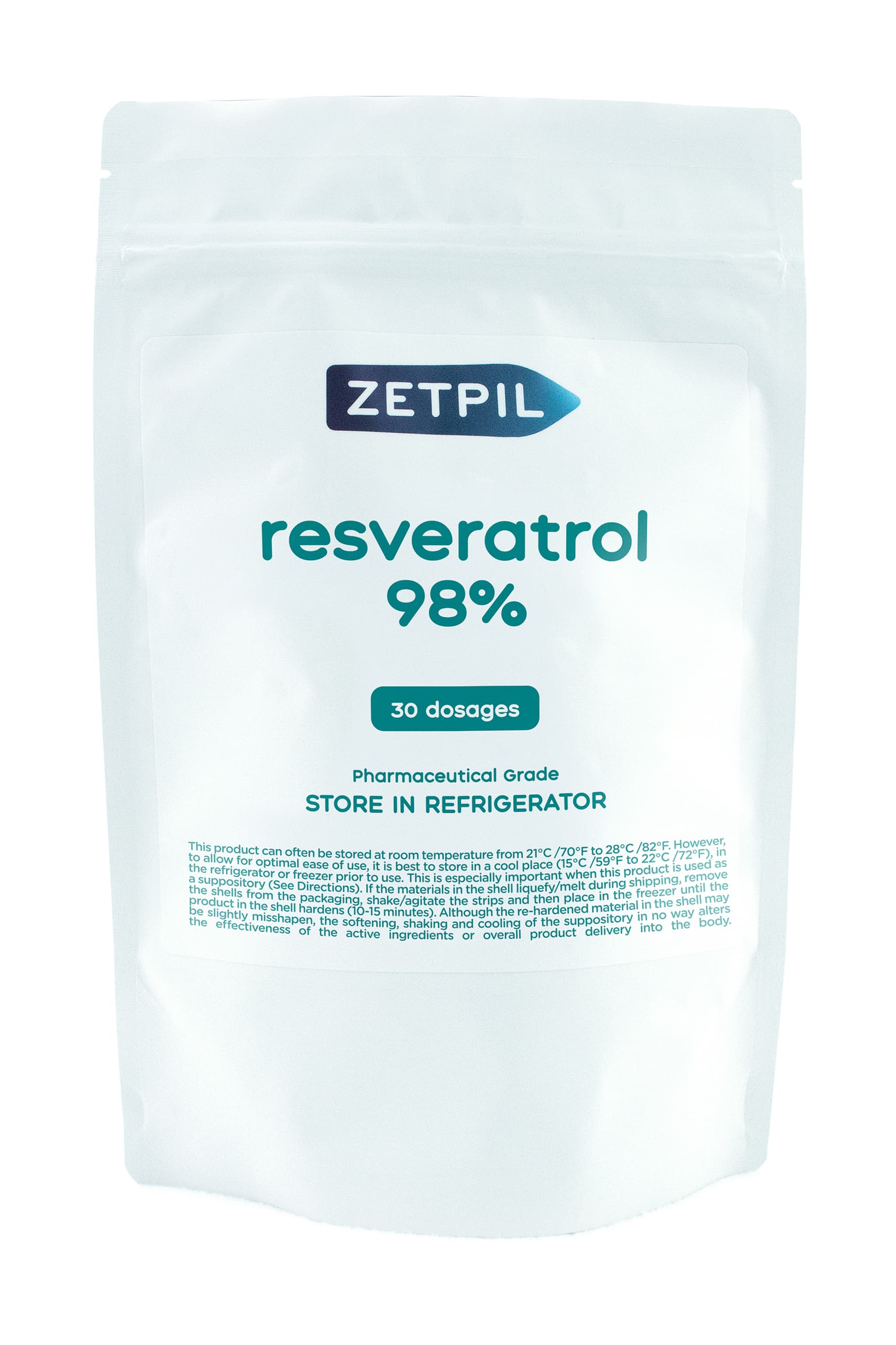
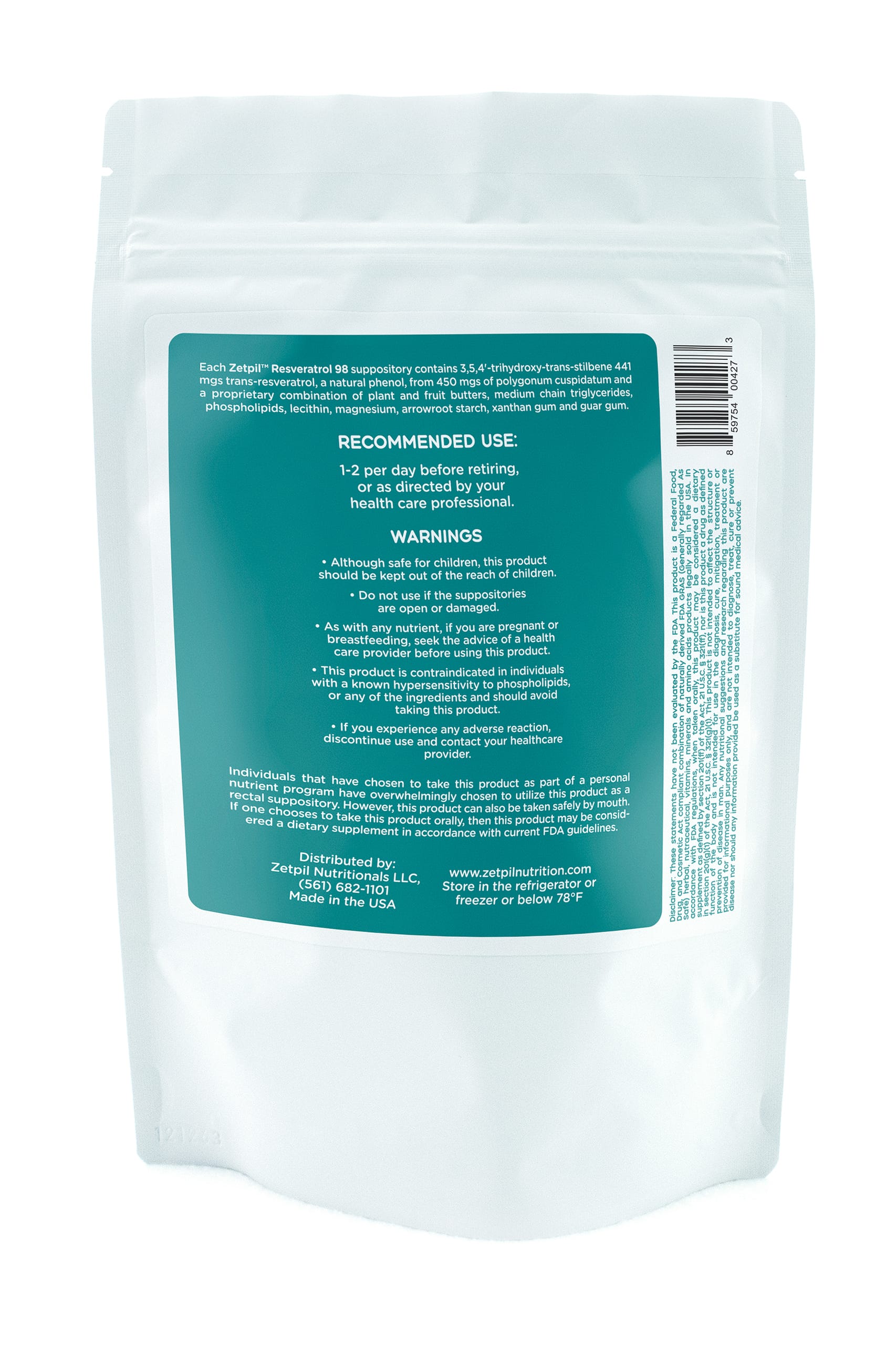
Zetpil™ provides 441mg of 98% trans-resveratrol per suppository, derived from Polygonum cuspidatum.
Supplement Facts
Serving Size: 1 suppository
Servings Per Package: 30
Each Zetpil™ 98% Trans-Resveratrol Suppository contains: Trans-Resveratrol – 441mg
From 450mg Polygonum cuspidatum, and a proprietary combination of plant and fruit butters, medium-chain triglycerides, phospholipids, lecithin, magnesium, arrowroot starch, xanthan gum and guar gum.
Recommended Use
Use one suppository per day before retiring, or as directed by your healthcare provider.
Always use products as directed. However, individual nutritional requirements can vary. Consult your healthcare professional regarding appropriate calcium and magnesium intake for your individual needs and whether this product is appropriate for you.
Storage and Use
This product can often be stored at room temperature from 21°C /70°F to 28°C /82°F. However, to allow for optimal ease of use, it is best to store in a cool place (15°C /59°F to 22°C /72°F), in the refrigerator or freezer prior to use. This is especially important when this product is used as a suppository (See Directions). If the materials in the shell liquefy/melt during shipping, remove the shells from the packaging, shake/agitate the strips and then place in the freezer until the product in the shell hardens (10-15 minutes). Although the re-hardened material in the shell may be slightly misshapen, the softening, shaking and cooling of the suppository in no way alters the effectiveness of the active ingredients or overall product delivery into the body.
For rectal use, clear the bowels before insertion when possible. The suppository may be moistened with cool water or used with a personal lubricant to facilitate insertion.
Follow the package directions for proper use.
Warnings
- Keep out of reach of children.
- Consult your healthcare provider before use if you are pregnant or breastfeeding.
- Consult your healthcare provider before use if you take medications, have a medical condition or have questions about whether this product is appropriate for you.
- Do not use if you have a known hypersensitivity to phospholipids or any of the listed ingredients.
- Do not use if the suppository or packaging is open or damaged.
- Discontinue use and contact your healthcare provider if you experience an adverse reaction.
Due to the nature of this product, suppositories cannot be returned or exchanged.
These statements have not been evaluated by the Food and Drug Administration. This product is not intended to diagnose, treat, cure or prevent any disease.
If you choose to use this product as a rectal suppository, it is highly recommended you attempt to clear your bowels prior to inserting it to avoid premature evacuation. To facilitate insertion it is recommended you moisten the product by passing it under a stream of cool water or use a personal lubricant. When used as a suppository, this product requires 15-20 minutes retention to ensure the complete absorption of the bioactive ingredients. This suppository can be inserted in any position. Although not required, if inserted while lying on one’s side, consider remaining in the supine position for 1-3 minutes following insertion. (Always insert flat end of suppository first).
Individuals that have chosen to take this product as part of a personal nutrient program have overwhelmingly chosen to utilize this product as a rectal suppository. However, this product can also be taken safely by mouth. If one chooses to take this product orally, then this product may be considered a dietary supplement in accordance with current FDA guidelines.
Disclaimer: These statements have not been evaluated by the FDA. This product is a Federal Food, Drug, and Cosmetic Act compliant combination of naturally derived FDA GRAS (Generally regarded As Safe) herbal, nutraceutical, vitamins, minerals and amino acids products legally sold in the USA. In accordance with FDA regulations, when taken orally, this product may be considered a dietary supplement as defined by section 201(ff) of the Act, 21 U.S.C. § 321(ff). Also, this product consists ONLY of a combination of naturally derived FDA GRAS (Generally regarded As Safe) herbal, nutraceutical, vitamins, minerals and amino acids products legally sold in the USA. Therefore, this product cannot be considered a drug as defined in section 201(g)(1) of the Act, 21 U.S.C. § 321(g)(1). This product is not intended to affect the structure or function of the body and is not intended for use in the diagnosis, cure, mitigation, treatment or prevention of disease in man. Any nutritional suggestions and research regarding this product are provided for informational purposes only, and are not intended to diagnose, treat, cure or prevent disease nor should any information provided be used as a substitute for sound medical advice.
References
References
There are more than 9,600 free peer-reviewed scholarly articles about resveratrol at the U.S. National Library of Medicine (www.ncbi.com). We encourage anyone looking for scientific and medical information to follow this link.http://www.ncbi.nlm.nih.gov/pmc/?term=resveratrol
Natural health products that inhibit angiogenesis: a potential source for investigational new agents to treat cancer—Part 1
S.M. Sagar, MD, et al
Curr Oncol. 2006 February; 13(1): 14–26
http://www.ncbi.nlm.nih.gov/pmc/articles/PMC1891166/pdf/CO13_1p014.pdf
Natural health products that inhibit angiogenesis: a potential source for investigational new agents to treat cancer—Part 2
S.M. Sagar, MD, D. Yance, MH, and R.K. Wong, MD
Curr Oncol 2006 June; 13(3): 99–107
http://www.ncbi.nlm.nih.gov/pmc/articles/PMC1891180/pdf/CO13_3p099.pdf
The journey of resveratrol from yeast to human
Aging (Albany NY) Mar 2012; 4(3): 146–158
Silvie Timmers, et al
http://www.ncbi.nlm.nih.gov/pmc/articles/PMC3348475/
Resveratrol-based combinatorial strategies for cancer management
Ann N Y Acad Sci Jul 2013; 1290(1): 113–121
Chandra K. Singh
http://www.ncbi.nlm.nih.gov/pmc/articles/PMC3713511/
Resveratrol: Biological and pharmaceutical properties as anticancer molecule
Biofactors 2010 Sep-Oct; 36(5): 360–369
Tze-chen Hsieh
http://www.ncbi.nlm.nih.gov/pmc/articles/PMC3655417/
Dose-Dependency of Resveratrol in Providing Health Benefits
Subhendu Mukherjee, Jocelyn I. Dudley, Dipak K. Das
Dose Response2010; 8(4): 478–500
http://www.ncbi.nlm.nih.gov/pmc/articles/PMC2990065/pdf/drp-08-478.pdf
Resveratrol: A Review of Pre-clinical Studies for Human Cancer Prevention
Mohammad Athar
Toxicol Appl Pharmacol. 2007 November 1; 224(3): 274–283
http://www.ncbi.nlm.nih.gov/pmc/articles/PMC2083123/
Transport, stability, and biological activity of resveratrol
Delmas D, et al
Ann N Y Acad Sci. 2011 Jan; 1215:48-59.
http://www.ncbi.nlm.nih.gov/pubmed/21261641
Resveratrol: challenges in translation to the clinic – A critical discussion
Lalita Subramanian, et al.
Clinical Cancer Research, 2010
http://clincancerres.aacrjournals.org/content/early/2010/10/29/1078-0432.CCR-10-1486
Therapeutic potential of resveratrol: the in vivo evidence
Joseph A. Baur & David A. Sinclair
Nature Reviews Drug Discovery 5, 493-506 (June 2006)
http://www.nature.com/nrd/journal/v5/n6/abs/nrd2060.html
Phytochemicals as Chemosensitizers: From Molecular Mechanism to Clinical Significance
Vinod BS, Maliekal TT, Anto RJ.
Antioxid Redox Signal 2012 Aug 7
http://www.ncbi.nlm.nih.gov/pubmed/22871022
Polyphenols and Aging
Brannon L. Queen and Trygve O. Tollefsbol
Curr Aging Sci 2010 February; 3(1): 34–42
http://www.ncbi.nlm.nih.gov/pmc/articles/PMC2896035/
Neuroprotective effects of resveratrol in Alzheimer disease pathology
Front Aging Neurosci 2014; 6: 218
Shraddha D. Rege, et al
http://www.ncbi.nlm.nih.gov/pmc/articles/PMC4161050/
Resveratrol Reverses Remodeling in Hearts with Large, Old Myocardial Infarctions through Enhanced Autophagy-Activating AMP Kinase Pathway
Kanamori H, et al
Am J Pathol 2012 Dec 27
http://www.ncbi.nlm.nih.gov/pubmed/23274061
Longevity nutrients resveratrol, wines and grapes
Istvan Lekli, et al
Genes Nutr (2010) 5:55–60
http://www.ncbi.nlm.nih.gov/pmc/articles/PMC2820197/pdf/12263_2009_Article_145.pdf
Scientific Evidence and Rationale for the Development of Curcumin and Resveratrol as Nutraceutricals for Joint Health
Ali Mobasheri, et al
Int J Mol Sci 2012; 13(4): 4202–4232
http://www.ncbi.nlm.nih.gov/pmc/articles/PMC3344210/pdf/ijms-13-04202.pdf
Curcuminoids and resveratrol as anti-Alzheimer agents
Villaflores OB, et al
Taiwan J Obstet Gynecol 2012 Dec; 51(4):515-25
http://www.ncbi.nlm.nih.gov/pubmed/23276553
High absorption but very low bioavailability of oral resveratrol in humans
Walle T, et al
Drug Metab Dispos 2004 Dec; 32(12):1377-82
http://dmd.aspetjournals.org/content/32/12/1377.full.pdf
Equipoise Lost: Ethics, Costs, and the Regulation of Cancer Clinical Research
David J. Stewart, et al
Journal of Clinical Oncology; VOLUME 28 _ NUMBER 17 _ JUNE 10 2010
http://jco.ascopubs.org/content/28/17/2925.full.pdf
Mucoadhesive drug delivery systems
Rahamatullah Shaikh, et al
J Pharm Bioallied Sci 2011 Jan-Mar; 3(1): 89–100
http://www.ncbi.nlm.nih.gov/pmc/articles/PMC3053525/?report=printable
Mucoadhesive drug delivery system: An overview
Bindu M. Boddupalli, et al
J Adv Pharm Technol Res. 2010 Oct-Dec; 1(4): 381–387
http://www.ncbi.nlm.nih.gov/pmc/articles/PMC3255397/?report=printable
Docetaxel-Loaded Thermosensitive and Bioadhesive Nanomicelles as a Rectal Drug Delivery System for Enhanced Chemotherapeutic Effect
Seo YG, et al
Pharm Res. 2013 Apr 3
http://www.ncbi.nlm.nih.gov/pubmed/23549753
Cardiotoxicity of Anticancer Drugs: The Need for Cardio-Oncology and Cardio-Oncological Prevention
Adriana Albini, et al
J Natl Cancer Inst. 2010 January 6; 102(1): 14–25
http://www.ncbi.nlm.nih.gov/pmc/articles/PMC2802286/?report=abstract&tool=pmcentrez
Resveratrol: Anti-Obesity Mechanisms of Action
Molecules 2014 Nov 14; 19(11):18632-18655
Aguirre L, et al